
BLOGGEN
HER FINDER DU KOMMENTARER, INDLÆG, BEGIVENHEDER OG SENESTE NYT FRA PROJEKT UDENFOR
Build systems with us, not around us
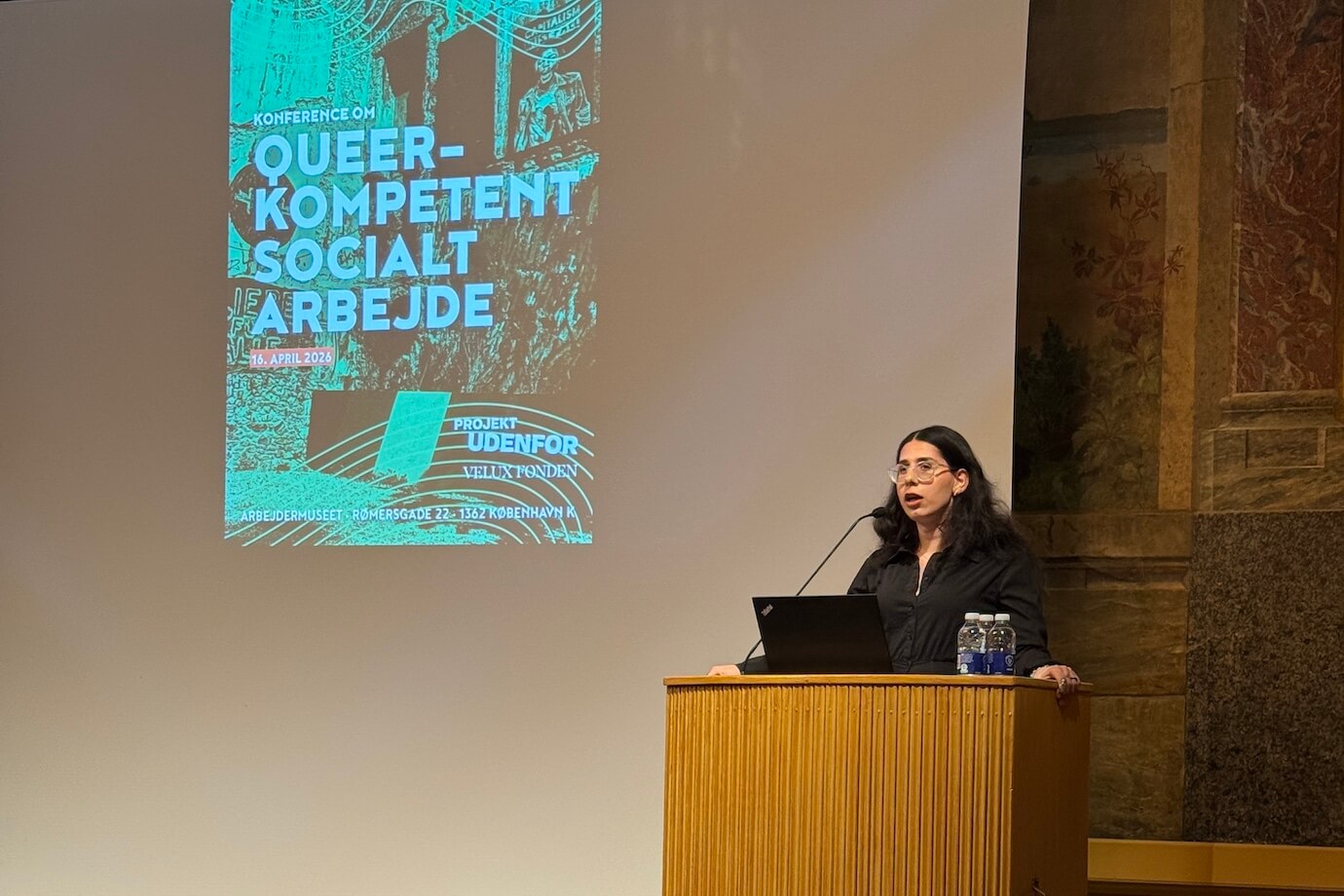
Tale af Zutana Hadaddeen, aktivist og artist.
Fra konferencen “Queerkompetent socialt arbejde” på Arbejdermuseet 16. april 2026. Følg og støt Zutanas arbejde her.
When we talk about homelessness, social vulnerability, and queer social work, we have to be honest about what we are really talking about. We are not only talking about housing. We are not only talking about services. We are not only talking about emergency support.
We are talking about who gets recognised as fully human inside the systems that are supposed to protect us.
Because the truth is: people do not become vulnerable in a vacuum. People become vulnerable in contact with structures that repeatedly fail them.
And for some of us, that failure starts long before homelessness. It starts in school. It starts in family rejection. It starts in being watched, questioned, misread, corrected, denied, and managed. It starts the moment your existence is treated as something difficult for other people to understand.
So when I stand here today as a brown woman of trans experience, I am not standing here to ask for pity.
I am standing here to ask for honesty.
Honesty about what it means to be a double minority in a country like Denmark.
Honesty about what it means to move through Copenhagen, through welfare systems, through institutions, through public space, knowing that you are not being read in the same way as everybody else.
And honesty about the fact that for many of us, the system is not built with us. It is built around us, above us, and too often against us.
We love to say in Denmark that we are progressive. We love the language of equality. We love the image of ourselves as safe, modern and inclusive. But equality as a national self-image is not the same as equality as a lived reality.
And the statistics tell us that very clearly.
In Denmark, trans people report discrimination at nearly four times the rate of cis gender people. Six in ten trans people have experienced discrimination, and more than four in ten have experienced violence.
And when race enters the picture, the situation gets even sharper. Among minority-ethnic LGBT+ people in Denmark, 55% reported discrimination within the last year, 44% were at risk of depression and long-term stress, and 34% had considered suicide within the past year. That is every third person. Not over a lifetime. Within a year.
So when we speak about “double minority,” this is what I mean.
I mean living at the intersection of transphobia and racism.
I mean being made hypervisible and invisible at the same time.
I mean being seen immediately as different, but not seen deeply enough to be understood.
I mean that before I have even spoken, the room has often already decided what I am.
Whether I am believable.
Whether I am complicated.
Whether I am safe.
Whether I am worth the effort.
And that matters in social work.
Because social work is never just about procedures.
It is about encounter.
It is about interpretation.
It is about power.
It is about what happens when someone sits across from you and decides, consciously or unconsciously, whether they are meeting a person or a problem.
And too often, trans women of color are treated as a problem to be managed, to be solved and to be handled.
Too complex.
Too marginal.
Too unfamiliar.
Too disruptive to the categories the system already knows how to handle.
But let me say this clearly:
We are not failing the system.
The system is failing us.


Project outside’s own work on LGBT+ homelessness says something many of us already know in our bodies: LGBT+ people in homelessness often feel misunderstood and rejected in their first contact with the system, and discomfort or outright unsafety can follow them through the system’s helping institutions. The report also points to “blind spots” in social work, shaped by dominant norms, that make it harder to meet LGBT+ people’s actual needs.
That language matters to me.
Blind spots.
Because a blind spot is not neutral.
A blind spot is where harm keeps happening while people still believe they are doing good. A blind spot is when a system says, “We treat everyone the same,” without understanding that treating everyone the same in an unequal society reproduces inequality. A blind spot is when a social worker believes they are being objective, while reading a trans woman of color through fear, bias, or assumption. A blind spot is when trans women of color are expected to explain themselves, educate staff, defend their names, their bodies, their gender, their safety, while already standing in crisis.
That is labour. And too often, it is unpaid labour extracted from the very people who came for help. And when help feels humiliating, unsafe, or dehumanising, people stop coming back.
That is one of the most important things this conference needs to sit with.
Because the question is not only why some LGBT+ people end up in homelessness or deep social vulnerability.
The question is also: what does the system do when they arrive?
Does it open?
Or does it tighten?
Does it listen?
Or does it categorize?
Does it understand intersectionality as a real practice?
Or does it use the word and then continue exactly as before?
Project Outside’s report is very clear that LGBT+ identity does not in itself create social vulnerability; rather, LGBT+ people can be pushed toward exclusion and homelessness through discriminatory social structures, worse health outcomes, and lower safety compared with the rest of the population. The report also notes that Denmark’s homelessness counts do not currently capture sexuality or gender identity beyond man/woman, which means the scale of LGBT+ homelessness here is still partly invisible.
That invisibility is political.
Because what is not counted is easier to dismiss.
What is not measured is easier to leave unsupported.
What is not named is easier to leave outside.
And yet, even with incomplete data, we already know enough to act.
We know trans people are more exposed to discrimination and violence.
We know minority-ethnic LGBT+ people have markedly worse mental health outcomes and higher exposure to discrimination.
We know LGBT+ people in homelessness describe being misunderstood, rejected, unsafe, and narrowed by heteronormative procedures when they seek help.
So no one in this room gets to say we did not know. The issue is not lack of warning.
The issue is whether we are willing to change the way care is imagined and delivered.
And that is where I want to speak directly to the social workers, decision-makers, educators, and institutions in this room.
I am asking you to listen differently.
Not defensively.
Not symbolically.
Not in a way where you hear our stories and then go back to business as usual.
I am asking you to listen in a way that costs something.
A way that changes intake forms.
A way that changes training.
A way that changes who gets hired.
A way that changes who is seen as an expert.
A way that changes how safety is defined.
A way that changes how fast harm is recognised when it happens to people like us.
Because queer social work cannot just be social work with better vocabulary.
It has to be social work with courage.
Social work with self-critique.
Social work with an understanding of race, gender, exclusion, and power.
Social work that does not ask us to become smaller and shrink in order to be helped.
And especially when we talk about trans women of color, I need us to understand this:
We are not an afterthought inside the category of LGBT+.
We are not an “extra complexity.”
We are not a diversity “checkbox.”
We are not a challenge for the profession to overcome.
We are human beings.
We are citizens.
We are culture-makers.
We are knowledge-bearers.
We are part of this city.
Part of this country.
Part of the future you keep saying you want to build.
So if this conference is serious about queer social work, then let it be serious in practice.
Do not just include us in panels.
Build systems with us.
Do not just study us.
Trust our analysis.
Do not just make room for our pain.
Make room for our authority.
Because I am not here today to translate my humanity into something more comfortable.
I am here to say that a system that cannot see the full humanity of a trans woman of color, is not a complete system.
A social practice that cannot hold complexity is not yet just.
And a city that calls itself safe while some of us move through it in constant negotiation has work to do.
Real work.
Urgent work.
And I hope that when we leave this room today, we do not leave with the feeling that we attended an interesting conversation.
I hope we leave with pressure.
Pressure to change what we normalise.
Pressure to change how we assess.
Pressure to change how we listen.
Pressure to make sure that the next trans woman of color, who enters a service is not treated as a disruption to the system, but as someone the system was always meant to serve.
That is the responsibility.
And that is the work to be done.
Thank you.